
A game that travelled the world
Before it became your family’s game, Happy Families had a long life: born in England, adopted in Germany, the Netherlands and France, it took a different shape and different families in each country.
The game’s journey
1 England · around 1851
London: Happy Families
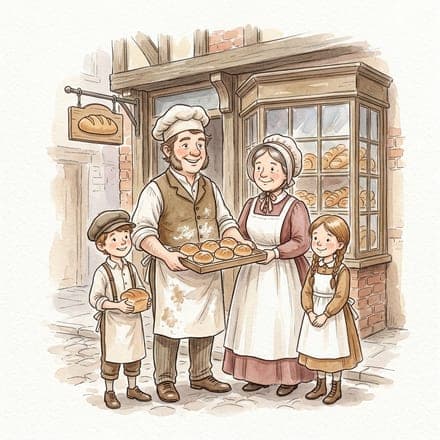
The game was published by Jaques of London, a maker of games and sports goods: most sources say it was shown at the Great Exhibition in London in 1851 (some date the first edition to 1861). It has never been out of print since.
The pack has 44 cards: 11 families of 4 characters (father, mother, son and daughter), with funny trade names such as Mr. Bun the Baker. The caricatured drawings are often attributed to John Tenniel, later the illustrator of Alice in Wonderland, though this has never been proven.
2 Germany · second half of the 19th century
In Germany, the Quartett
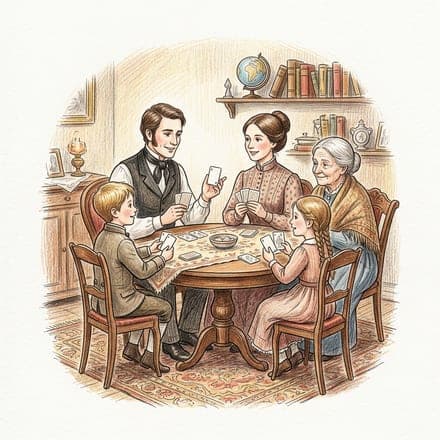
Collecting families of four cards was also played in German-speaking countries, as Quartett. First designed for adults in middle-class salons, these games were meant to teach: geography, history, art, natural history.
Quartets for children appeared in the 1870s. They still exist on every topic imaginable, from cars to aeroplanes.
3 Netherlands · from the 1870s
In the Netherlands, the kwartet
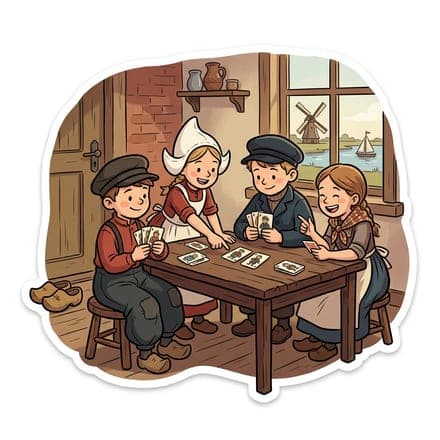
German makers also sold their quartets in the Netherlands, where the kwartetspel became a children’s classic. It was a way to learn by playing: some quartets told Bible stories, others the history of the country, like the “national quartet” of 1913, for the centenary of independence.
4 France · around 1876
In France, seven families of six
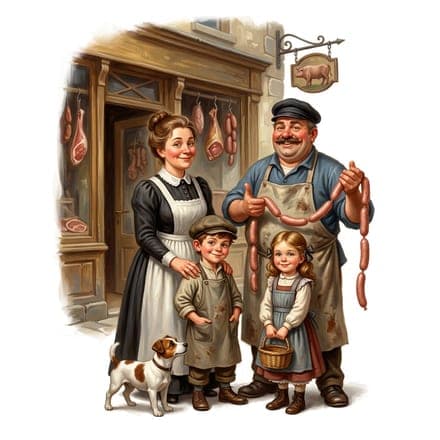
The French game took its own shape: 7 families of 6 characters. According to collectors, the oldest known one dates from 1876 and was drawn by the caricaturist André Gill, for adults at first.
Soon the families became the familiar ones: trades with comic names, the baker, the butcher and the rest, then every theme imaginable, from animals to comic-book heroes.
5 United States · today
An American cousin: Go Fish
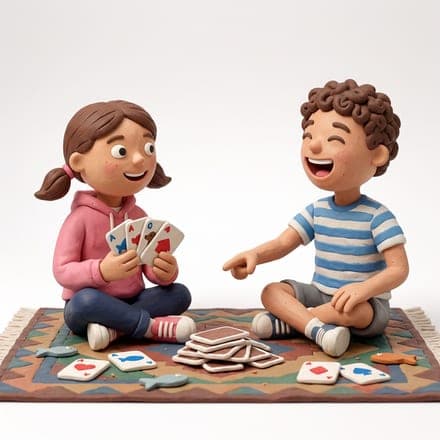
In the United States, children play Go Fish with an ordinary 52-card deck: you collect cards of the same rank, and whoever doesn’t have the card asked for sends the other player… fishing in the draw pile. The same fun, without illustrated cards.
And today: your family
For more than a century and a half, the game’s families were made up: bakers, scholars, animals. My Happy Families makes your own tribe the heroes of the game, with its passions, quirks and stories.
Create your family’s game